ASD assessment in Echo
- Identify ASD;secundum, primum, sinus venosus ASD, coronary sinus defect
- Assess, maximum ASD defect in multiple orientation, shape, shunt direction of the shunt- left to right, colour doppler flow
- The rims of the ASD, – important for ASD closure device closure.
- look for overlume overloaded, RV dilatation, RV dilatation, increase in the RV volume,
- Estimate PASP – 4 TR max ^2 + RAP
- PA size, RV function, TR severity, PVR
- Calculate shunt, Qp/Qs >1.5 RHC
- RV function, TAPSE, RV S;
- Associated anomalies. ( PH, TR, Aortic root dilatations,
ASD → L→R shunt → RA/RV volume overload → pulmonary circulation
Another patient we did TOE.
understanding the rim of ASD
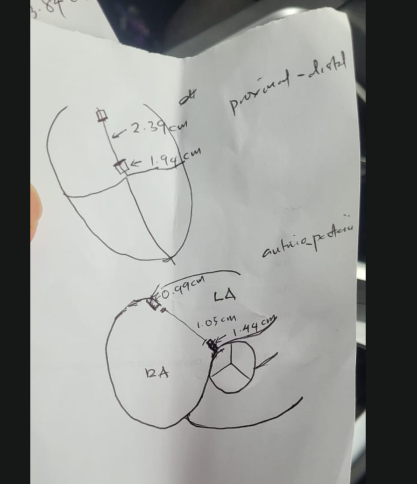
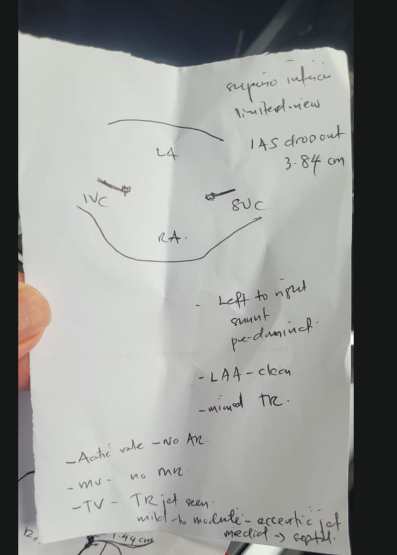
I wonder if we do 3D Echo can we even see better.
Ada 1 machine Echo yang hebat har itu maybe boleh guna untuk patient ni
Different patient, form Journal
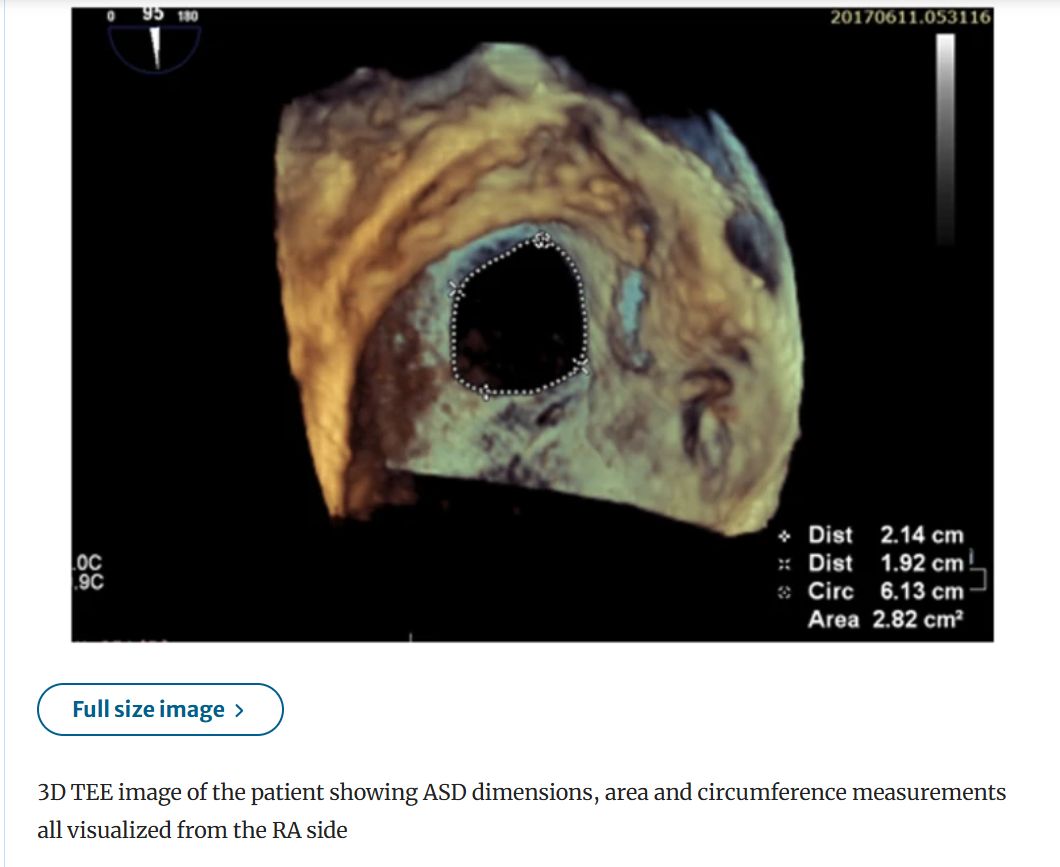
So next we will do RHC for 1 of our patient.
So what will we know about this patient later ?
1. Oxygen saturation step-up — confirms/quantifies L→R shunt
Take saturations from:
- SVC
- IVC
- Right atrium
- RV
- PA
- Systemic arterial sample
With an ASD, you typically see an oxygen saturation step-up at the RA level because oxygenated LA blood enters the RA.
2.Qp/Qs — size of the shunt
Using Fick principle:
Conceptually:
≥1.5 → generally considered a significant shunt in ASD assessment, provided the clinical context supports closure.
Qp/Qs = 1 → no significant shunt
>1 → L→R shunt
3. Pulmonary artery pressure
Measure:
- mPAP
- PASP
- PADP
This determines whether pulmonary hypertension is present.
4. Pulmonary capillary wedge pressure (PCWP)
Important because elevated PCWP suggests post-capillary pulmonary hypertension from left-heart disease rather than isolated pulmonary vascular disease.
5. Pulmonary vascular resistance — PVR
Units:
Wood units (WU)
Example:
mPAP = 45 mmHg
PCWP = 10 mmHg
CO = 5 L/min
This is important because high PVR changes the safety and appropriateness of ASD closure.
6. RHC can distinguish the type of pulmonary hypertension
| RHC finding | Interpretation |
|---|---|
| mPAP normal | No PH |
| mPAP elevated + PCWP ≤15 | Pre-capillary PH |
| mPAP elevated + PCWP >15 | Post-capillary PH |
| High Qp/Qs + low/moderate PVR | Significant ASD shunt |
| High PVR | Pulmonary vascular disease; closure requires caution |
7. Important in ASD closure
The RHC question is essentially:
“Is this ASD causing a significant shunt, and has it produced irreversible pulmonary vascular disease?”
So before closure, particularly in an ASD patient with suspected PH, you want:
mPAP + PCWP + CO + PVR + Qp/Qs + oxygen saturation step-up.
If you give me the RHC numbers (SVC/IVC/RA/RV/PA sats, pressures, PCWP and cardiac output),
banyak lagi ni kena belajar.
ASD assement for device closure.
14.10.2026 nanti kita update balik pasal kes ni.
—
Disclaimer this is a self learning note ok. Jangan saman.
Reference.
untuk baca





 DrMKZ
DrMKZ 
Leave a comment